
AMD Ryzen AI Halo Explained: What It Is, What It Costs, and Who It's For
AMD's Ryzen AI Halo is a desktop built for running massive local LLMs. We break down the memory arithmetic, performance trade-offs, and 128GB pricing.
Table of Contents (8 sections)›
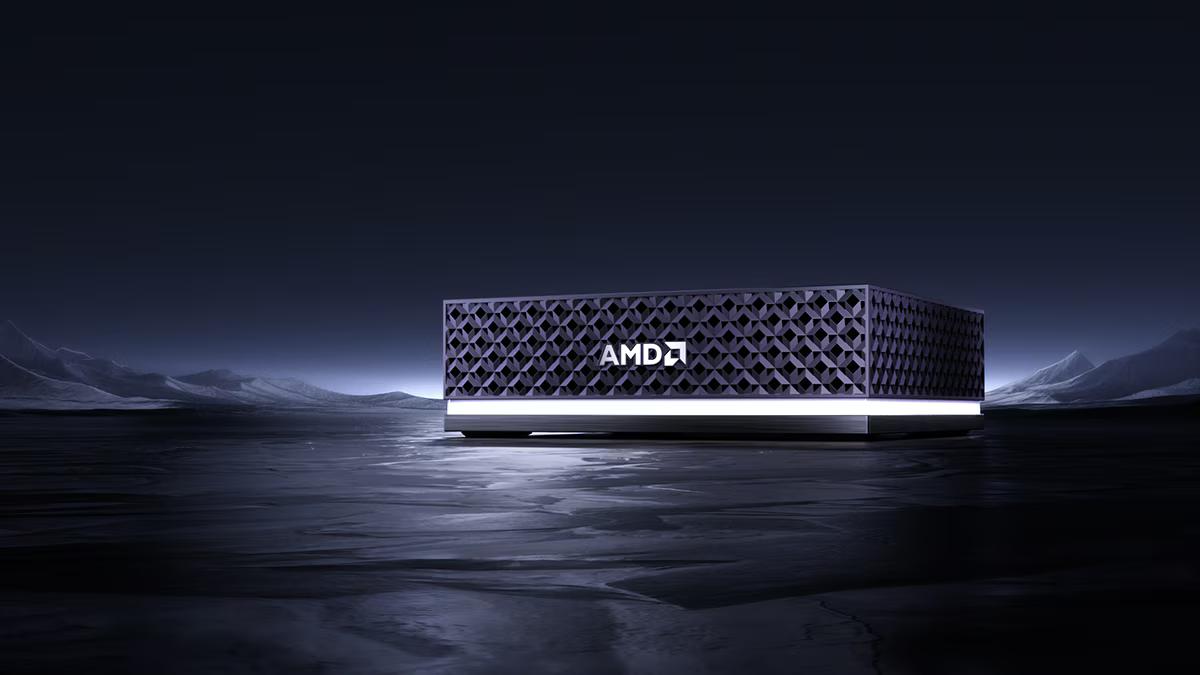
Research-based guide. I haven't tested this hardware. This article summarizes AMD's announcements and independent reviews, links every source, and adds my own explanation of what the numbers mean for buyers.
Quick take
- The Ryzen AI Halo is a small desktop PC that AMD sells as a developer platform for running AI models locally. It is not a gaming PC.
- There are now two versions: the original 128GB model with the Ryzen AI Max+ 395 (listed at $3,999) and a 192GB model with the Ryzen AI Max+ PRO 495, which AMD announced on October 12, 2026.
- Its big advantage is memory capacity. Its weak spot, according to reviewers, is speed on long prompts compared with Nvidia's DGX Spark.
- If your models fit in 128GB, the Halo is the cheaper option and runs Windows or Linux, while the Spark is faster on some tasks. If you need more than 128GB, the 192GB Halo is the option AMD is promoting for that.
What AMD has announced
Original Ryzen AI Halo (128GB)
- AMD introduced it at CES 2026 as an AI developer platform, and PCWorld reported AMD's claim that it can run models of up to 200 billion parameters locally.
- It uses the Ryzen AI Max+ 395: 16 Zen 5 CPU cores, 40 RDNA 3.5 GPU compute units, and a 50 TOPS NPU, according to HotHardware's hands-on. With 128GB of total memory, the GPU can access up to 96GB.
- It supports Windows or Linux and ships with AMD's ROCm software, per AMD's announcement. It is sold exclusively through Micro Center, with pre-orders that began in June 2026.
- Engadget reported the starting price as $3,999.
Newer Ryzen AI Halo (192GB), announced October 12, 2026
- AMD's post says it uses the Ryzen AI Max+ PRO 495 with up to 192GB of unified LPDDR5X memory, 16 Zen 5 cores, 40 RDNA 3.5 compute units, and up to 55 TOPS of NPU performance.
- AMD says up to 160GB can be allocated to the GPU, enough for 300-billion-parameter models at 4-bit quantization.
- Windows versions using Microsoft's Project Zenith are listed as coming soon, with no date.
- AMD's post doesn't give a price. TechTimes reports $7,299.99 for a Linux configuration at Micro Center. Check Micro Center before relying on that figure.
Why memory matters more than the chip name
A model's weights have to fit in memory before it can run. As a rule of thumb, at 4-bit quantization each billion parameters takes roughly half a gigabyte:
- A 70-billion-parameter model needs about 35GB.
- A 200-billion-parameter model needs about 100GB.
- A 300-billion-parameter model needs about 150GB, plus extra room for the context the model keeps in memory (the KV cache).
That is why AMD's 160GB figure matters. These are my own estimates, not AMD's numbers. The Halo shares one pool of memory between the CPU and GPU, so much more of it is available to the model than on a typical graphics card.
Why it can still feel slow: bandwidth
When a model generates text, the system reads the model's weights from memory for every token. A useful rule of thumb is that tokens per second cannot exceed memory bandwidth divided by the data read per token.
- The original Halo's memory runs at about 256GB/s, according to Memeburn's review. TechTimes reports about 273GB/s for the 192GB model, which matches a 256-bit bus at 8,533 MT/s.
- A dense 70B model at 4-bit reads roughly 40GB per token, so the ceiling is about 6 tokens per second at 256GB/s. Real speeds are lower.
- A mixture-of-experts model that activates about 3B parameters per token reads only 1.5 to 2GB, so the ceiling is in the hundreds of tokens per second.
This explains the pattern reviewers saw. XDA Developers measured roughly 70 to 90 tokens per second on a 30B mixture-of-experts coding model, depending on the software backend (ROCm or Vulkan). Dense models of similar memory size run much more slowly.
What independent reviewers found (original 128GB model)
- Tom's Hardware found that tokens-per-second throughput was acceptable, but time to first token fell behind Nvidia's GB10 systems as context length grew, and that the Halo didn't change what other Strix Halo systems already deliver.
- StorageReview ran Phoronix and vLLM serving tests and found the DGX Spark ahead in most of them. In one decode-heavy test at batch size 64, the Halo reached 127 tokens per second against the Spark's 305. In a prompt-heavy test, it reached about half the Spark's throughput. The Spark also led three memory-bandwidth tests by 13 to 17 percent, while the Halo led the Copy test by 18 percent.
- XDA Developers ran sustained tests for 30 minutes at comfortable temperatures. It found the NPU slower than the GPU for text generation (about 11 tokens per second on an 8B model, against about 41 on the GPU) but very consistent.
My takeaway: the Halo looks fine for single-user chat with mixture-of-experts and mid-sized models, and weaker for long prompts, long contexts, and serving many users at once. As of October 21, 2026, I haven't found independent reviews of the 192GB model, so treat its performance as unverified.
How to read AMD's 34x claim
AMD's October 12 post shows charts claiming up to 34.3x the throughput of an Apple M5 Pro system and up to 32.2x that of an Intel Core Ultra X9 388H system across 18 generative AI workloads. The footnotes matter:
- AMD ran the tests itself, in ComfyUI, in September 2026.
- AMD's system had 192GB of memory, while the comparison systems had 64GB.
- Some workloads are marked DNR (did not run) on the comparison systems, and AMD says no speedup ratio was calculated where a result was DNR.
These are vendor numbers. They show what fits in memory more than a head-to-head speed contest.
Who should consider it
- You want to run 70B to 200B models locally and prefer Windows or Linux on x86. The original 128GB Halo is the value pick at $3,999, compared with the DGX Spark at $4,699 according to Engadget. The trade-offs are slower prompt processing and a software ecosystem (ROCm) that is smaller than Nvidia's CUDA, so check that your tools support it first.
- You need models above 128GB, such as 300B-class models at 4-bit. The 192GB model is the one AMD offers for that, at a much higher price, and Windows versions are not out yet.
- You mainly game or build general-purpose PCs. Skip it. PCWorld noted that most people won't buy the Halo itself, though consumer machines such as the Framework Desktop use the same chip.
- You're comparing it with paying for cloud AI. AMD's own pitch, as reported by Engadget, is that heavy users spending around $773 a month on AI tokens could pay off the Halo in about six months. That is AMD's example, not a general rule.
Availability outside the US
AMD says the Halo is sold through Micro Center, a US retailer. If you're elsewhere, availability, shipping, and import costs may differ, so check local resellers. Memory-heavy systems can also change price, so recheck before you buy. For background on why, see our memory pricing explainer. If you're curious about small, low-power alternatives, see our mini-PC guide.
Products mentioned
As an Amazon Associate, Antquinox earns from qualifying purchases. Product availability and pricing are subject to Amazon.