
The 50%–70% PSU Efficiency Sweet Spot: Why Proper Sizing Saves Power and Reduces Noise
Understanding the 80 PLUS and Cybenetics efficiency curves: why sizing your power supply to operate between 50% and 70% load lowers thermal output, reduces fan RPM, and prolongs capacitor lifespan.
Table of Contents (5 sections)›
When shopping for a desktop PC power supply, many builders focus exclusively on the headline wattage number: 'My PC draws 450W, so a 500W power supply is enough.' While that logic is mathematically sufficient to boot Windows, it ignores the fundamental physics of switching-mode power supplies (SMPS). Operating a power supply near its maximum continuous capacity generates excessive internal heat, forces cooling fans to run at maximum RPM, and accelerates component degradation.
To achieve optimal energy efficiency, silent acoustics, and component longevity, experienced system architects design systems around the **50% to 70% efficiency sweet spot**.
1. The Efficiency Bell Curve: 80 PLUS vs. Cybenetics
Every desktop power supply converts alternating current (115V/230V AC from the wall) into direct current (+12V, +5V, +3.3V DC) required by computer silicon. This conversion is never 100% efficient; electrical energy lost in the process is converted into thermal heat.
- Low Load Inefficiency (<20% Load): At very light loads (such as idle desktop browsing drawing 50W on an 850W unit), switching losses in the primary MOSFETs dominate, dropping efficiency to 75%–82%.
- The Peak Efficiency Sweet Spot (50% Load): Every high-quality power supply achieves its highest electrical efficiency at exactly 50% of its rated capacity. In this zone, resistive losses ($I^2R$) and switching losses reach an optimal equilibrium. An 80 PLUS Gold unit converts 90%+ of wall power into usable DC current.
- High Load Degradation (>85% Load): As a power supply approaches 90% to 100% load, internal resistance across inductors, transformers, and PCB copper traces increases exponentially. The unit generates substantial waste heat, dropping efficiency by 4% to 6%.
2. Acoustic Benefits: The Zero-RPM Fan Curve
The most immediate real-world benefit of proper PSU sizing is acoustic silence:
- Zero-RPM Hybrid Fan Modes: Virtually all modern high-efficiency power supplies (from brands like Corsair, Seasonic, be quiet!, and Thermaltake) feature a semi-passive or hybrid fan switch. The internal cooling fan stays completely powered off until internal temperatures or electrical loads exceed 40% to 50%.
- Silent Gaming: If your gaming rig draws 400W and you use a 500W PSU (80% load), the tiny 120mm PSU fan will spin at maximum RPM (1,800+ RPM) to prevent overheating, producing noticeable acoustic whine. If you use an 850W PSU for that same 400W load (47% load), the fan will either remain completely off or spin at an inaudible 500 RPM.
3. Component Longevity & The Arrhenius Law
Inside every power supply, electrolytic capacitors smooth out voltage ripple. The lifespan of these critical components is governed by Arrhenius' law of chemical reaction rates:
- The 10°C Rule: For every 10°C decrease in internal operating temperature, the operational lifespan of electrolytic capacitors is doubled.
- Lower Internal Thermal Stress: Operating a power supply at 50%–60% load produces less than half the internal waste heat of running at 90% load. This keeps internal temperatures well under 50°C, ensuring that quality 105°C Japanese capacitors easily survive their full 10-year factory warranties.
4. Sizing Your System for the Sweet Spot
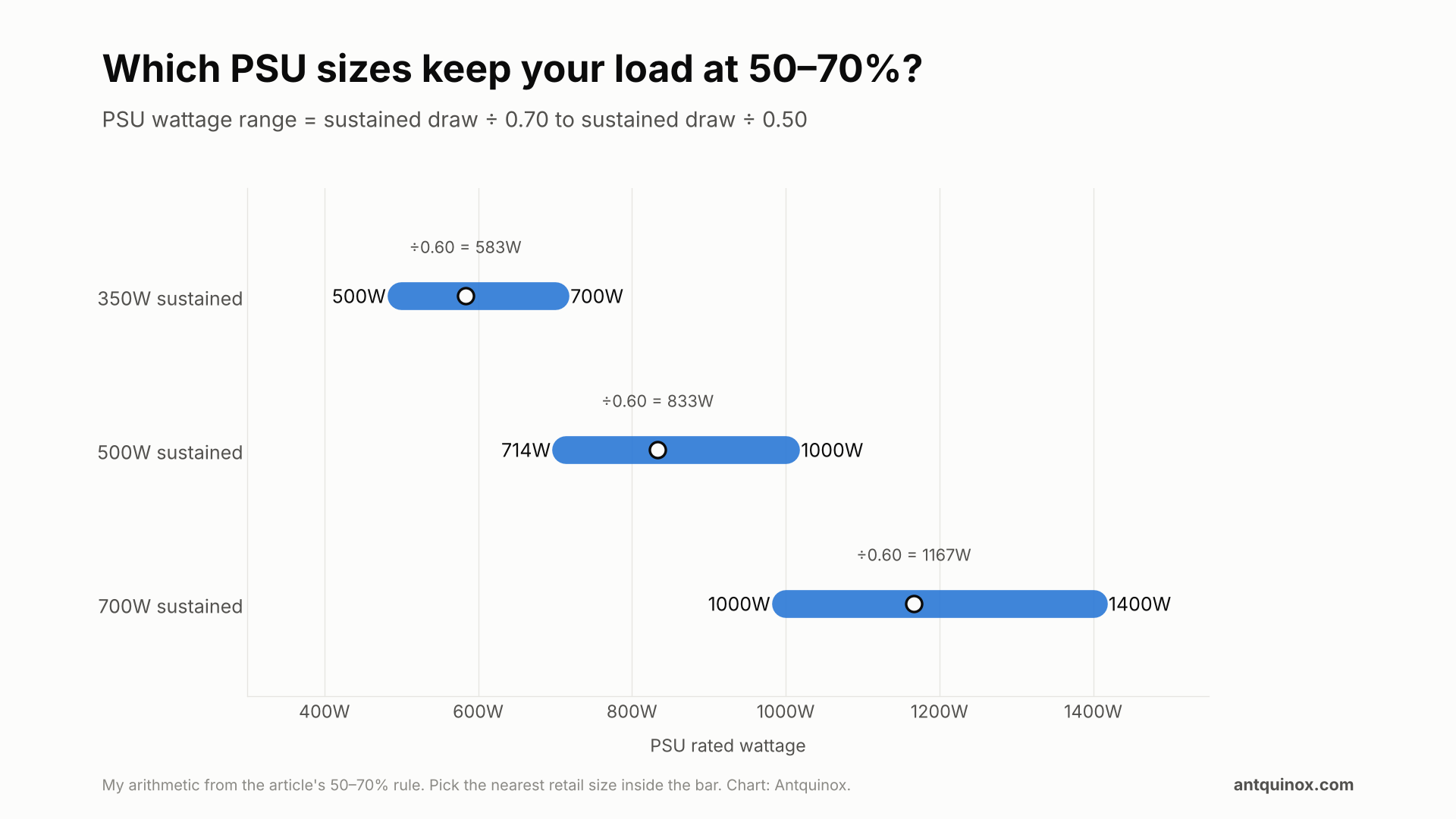
To size for optimal efficiency, take your continuous sustained gaming load and divide by 0.60 (or multiply by 1.6x):
- Sustained 350W Draw: $350W \div 0.60 = 583W$ → Target a **650W to 750W PSU**.
- Sustained 500W Draw: $500W \div 0.60 = 833W$ → Target an **850W PSU**.
- Sustained 700W Draw: $700W \div 0.60 = 1166W$ → Target a **1200W PSU**.
5. Test Your System's Optimal Efficiency Curve
Our Transient Power & PSU Sizer implements this exact 50%–70% load curve algorithm. It models your component wattages, calculates peak microsecond excursions, and automatically quantizes your target up to vetted retail ATX 3.1 power supply tiers.